What Angola Taught Us About Tourism Market Maturity
We landed at Luanda's new multi-billion-dollar airport, and it was giving Primary Market. Sleek terminals, modern infrastructure, the kind of arrival experience you'd expect in an established international gateway. Then we tried to pay for anything with a credit card, and quickly learned that foreign cash was accepted almost nowhere. Changing money felt like stepping onto a 1980s Wall Street trading floor.
That contradiction was the first sign that the frameworks we knew for evaluating tourism markets didn't fully account for what we were seeing on the ground.
We were in Angola this summer as part of a tourism readiness project with Oxford Economics, evaluating what it takes for a destination across Sub-Saharan Africa to become tourism ready. We went in thinking about "emerging" markets. The deeper we got, the more we realized emerging wasn't the beginning of the story. Sometimes, there are two stages before it.
On the Ground
The road to Kalandula Falls had potholes the size of goats. But the falls, the welcome from local communities, and a night at Pousada Kalandula were worth every bump. We bartered with baseball caps, tangerines, and cookies. Lesson learned: bring more cookies.
In Cabo Ledo, the journey itself reflects the realities of what we'd come to call a Pre-Emerging tourism market. Access is difficult, roads are still developing, and the surrounding tourism infrastructure remains limited. Yet Cabo Ledo has earned international recognition for its surfing, and properties like Eco Carpe Diem are creating distinctive, nature-driven stays overlooking a nearly untouched coastline. Travelers are already making the journey, in part because it isn't highly developed yet.
Then there's Pululukwa Resort in Lubango, where private bungalows sit within an expansive natural environment, offering a luxury hospitality experience built around nature, privacy, and serenity. It's an important contrast to Cabo Ledo: a destination doesn't need a fully developed tourism ecosystem before sophisticated travelers begin to arrive. Individual hospitality products and compelling natural experiences can emerge well ahead of the broader market around them.
And yes, we tried the local moonshine: maruvo, a palm wine that gets bolder by the hour, and a sugarcane firewater that earns its name.
Building the Framework
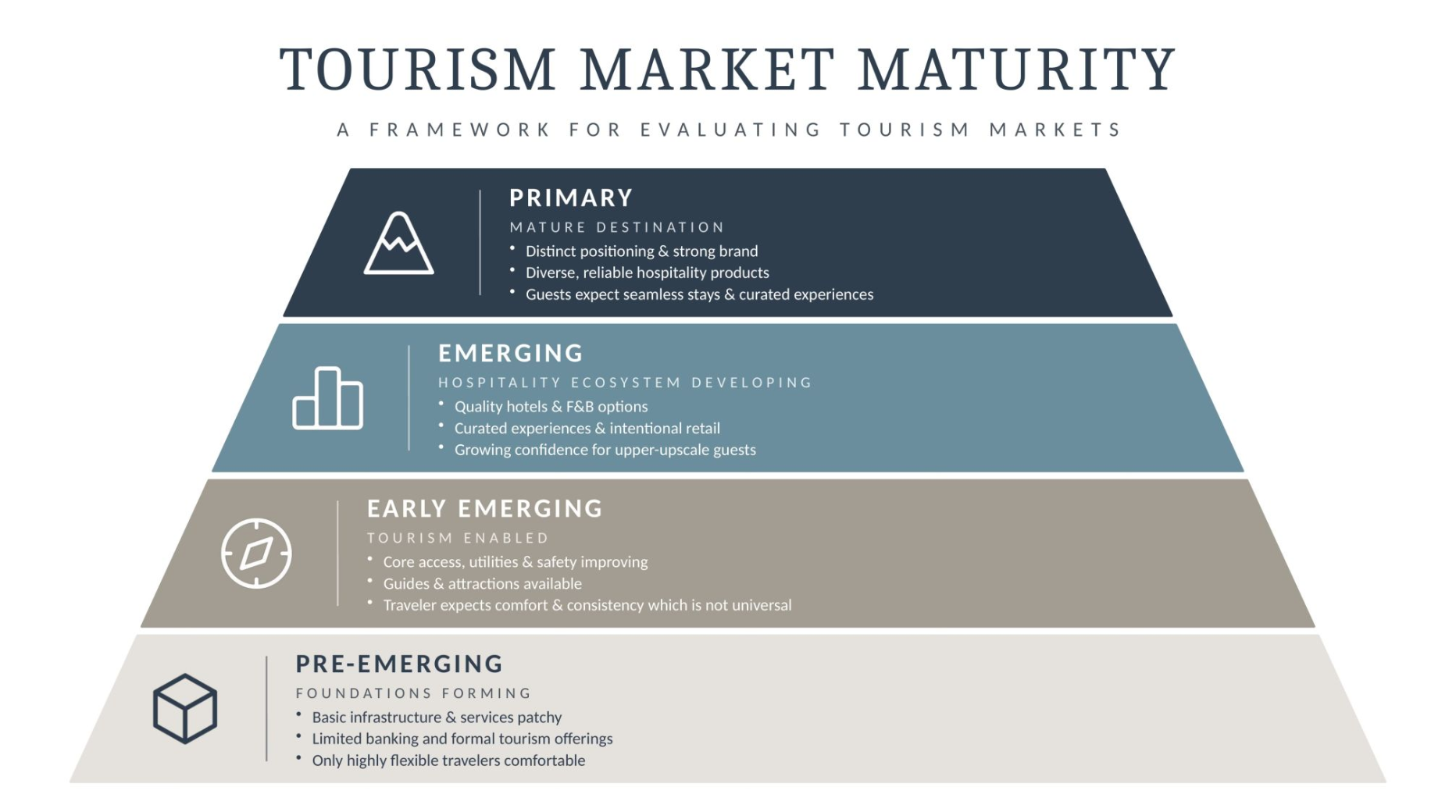
That realization, that "emerging" can describe wildly different realities depending on what's actually built and accessible, led us to develop HGA's Tourism Market Maturity pyramid, a nod to Maslow's hierarchy of needs.
The framework identifies four stages: Pre-Emerging, Early Emerging, Emerging, and Primary. Unlike broader economic development models, it's built specifically around tourism markets, where the presence of a single distinctive property or natural asset can outpace the maturity of everything around it.
Each stage carries different priorities, investments, infrastructure needs, and hospitality strategies. A Pre-Emerging destination like Cabo Ledo needs different support than a Primary market like Luanda's airport corridor, even though both can coexist within the same country. Trying to leap ahead of a market's actual stage, layering in Primary-market infrastructure or pricing before the foundations exist, creates its own set of challenges.
The Takeaway
Sophisticated travelers don't wait for perfect infrastructure. They come for extraordinary landscapes, distinctive hospitality, and the elusive feeling of discovering a place most people haven't found yet. Every stage of a tourism market has its own magic and its own priorities.
Strategy has to meet a destination where it is, not where we assume it should be.
Written by Anna Gomez, Partner of HGA.